The Travelling Symphony arrives at Severn City Airport
Station ElevenThe Travelling Symphony’s arrival at Severn City Airport is a turning point from exposure on the road to shelter among a settled community. The travelers approach a guarded airport expecting uncertainty; instead, a sentry’s recognition transforms a wary checkpoint into a reunion. Their five-week stay brings rest and repairs, while Shakespeare and music leave a lively trace in the settlement after the performers depart.
The Road to the Airport
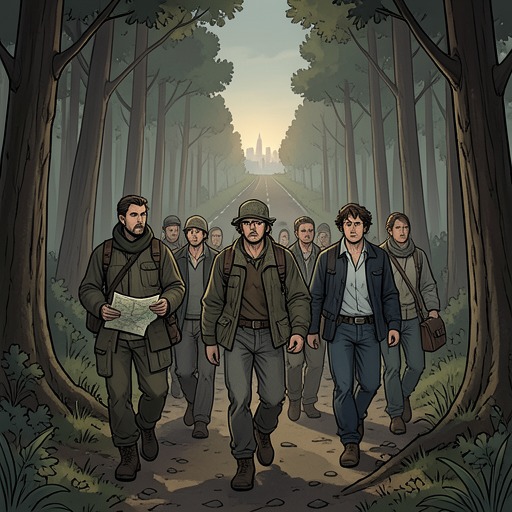
The approach follows a journey through a world where movement has become slow, precarious, and difficult to separate from danger. After leaving the bodies on the road, Kirsten Raymonde, August, and Sayid continue toward the airport, with the dead Prophet’s dog trailing them at a distance. During a rest, Kirsten calls the dog Luli and offers him dried venison. He accepts the food, lets her stroke his head, and stays beside her as they set out again. This small act of trust accompanies the group into the last stretch of the journey.
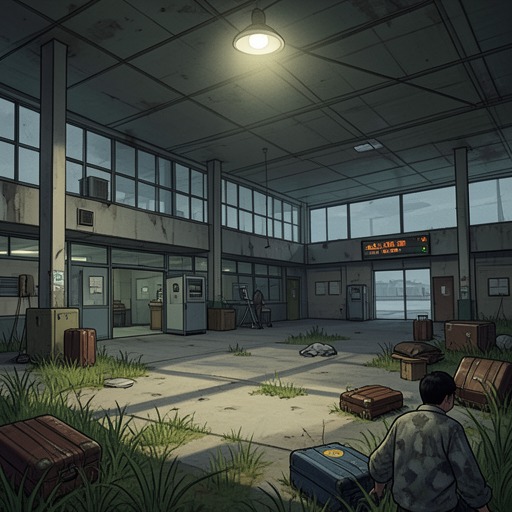
The airport comes into view when the road curves out of the trees: a large, two-storey terminal of concrete and glass above an expansive parking lot. Kirsten believes they are likely being watched, but sees no movement in the landscape. Luli raises his nose, and August identifies the smell of roasting deer. The road divides into lanes for Arrivals, Departures, and Parking. Sayid chooses Departures, joking about the possibility of leaving the continent; his last airport experience had been a flight into Chicago O’Hare two months before the Collapse. The choice leads the travelers toward the terminal’s raised entrance, where their arrival will be met not with an open route onward but with a community behind a guarded threshold.
That contrast reflects the altered meaning of air travel. Before the Collapse, airplanes carried people across distances and offered views of illuminated towns from above. In the changed world, many aircraft stand dormant on runways and in hangars, repurposed for food storage or abandoned to rust. The terminal remains, but its function has shifted: the travelers come to it on foot, and its doors mark the entrance to a settlement rather than a passage to another city.
The Sentries and the Welcome
A hundred yards from the glass-and-steel revolving doors, the travelers hear three short whistle blasts. Two sentries step out from behind a municipal bus, a woman and a man, with their crossbows pointed at the ground. The man begins a courteous explanation of the precaution, but breaks off when the woman drops her bow and runs toward the newcomers. Laughing, shouting their names, and trying to embrace them all at once, she replaces the checkpoint’s formal caution with immediate recognition.
The moment matters because it reverses the expectation established by the sentries’ weapons. The airport is not an unguarded ruin, and entry is not presented as effortless: the travelers approach under watch, with their hosts prepared to defend the settlement. Yet the greeting shows that the arrivals are known to someone inside. The boundary remains real, but it opens through personal connection rather than force. The scene turns the terminal from a distant structure that might conceal danger into a place where the travelers can be received.
There are 320 people living at Severn City Airport in the year of the arrival, making it one of the largest settlements Kirsten has seen. The newcomers’ needs are immediate. August takes Sayid to the infirmary, while Kirsten lies dazed in Charlie’s tent. The welcome therefore leads directly into care and rest, not merely a ceremonial reunion: the settlement has people and spaces able to receive travelers who arrive exhausted and in need of help.
A Settlement Made into a Temporary Home
The airport has been adapted to the requirements of life after the Collapse. By the beginning of the second year, its occupants had arranged a double line of tents along Concourse B. Branches brought in from the woods formed the frames, and salvaged sheets were stapled over them. The tents varied in size, but many measured about twelve feet square and had peaked roofs. Their construction answered a practical need for shelter while also answering the residents’ desire for privacy: people were tired of looking at one another, yet reluctant to sleep far apart.
Charlie and Jeremy’s tent provides a more particular picture of that domestic life. It contains a bed, two plastic crates for clothes and diapers, and the couple’s instruments. Light filters through the fabric, and Luli crowds inside to lie beside Kirsten. The airport is no longer simply a terminal occupied by stranded passengers; ordinary rooms and routines have been assembled within its concourses, and the dog’s presence carries the road’s fragile companionship into this improvised home.
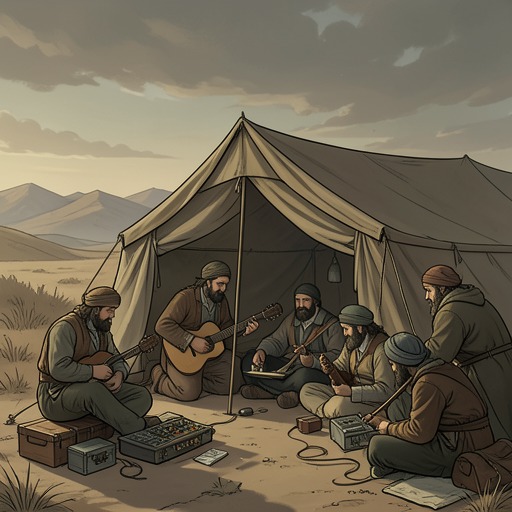
The Travelling Symphony stays for five weeks. During that time, its members rest, repair their caravans, and perform Shakespeare and music on alternate evenings. The stay brings the routines of a touring company into a settlement whose residents have made shelter within an abandoned transportation hub. Performance is part of the visitors’ life there, but their departure will make its impact visible in the people who remain.
Departure and Lasting Significance
When the Travelling Symphony leaves on a bright morning in September, the settlement retains an echo of its visit. Garrett hums a Brandenburg concerto while working in the gardens; Dolores whispers Shakespeare fragments as she sweeps the concourse; and children practise swordplay with sticks. These scattered repetitions show how the company’s performances continue as gestures and sounds after the wagons have gone. Clark, meanwhile, retreats to the Museum of Civilization and thinks of the travelers carrying their Shakespeare, weapons, and music down the coast.
Before leaving, Kirsten gives Clark one of her two Dr. Eleven comics. Parting with it pains her, but the Symphony is entering unknown territory, and she wants at least one copy to remain safe in case of trouble on the road. The handover links the travelers’ uncertain onward movement to the museum’s work of preserving human-made objects and stories. The arrival thus opens a temporary period of safety without ending the road: the performers repair, perform, share their company and artifacts, and then resume traveling, while the airport settlement continues to carry traces of what they brought.